SEASON 10: S02 W3 — SUMMARY: "LET'S BE HONEST..."


Season 10 (2026) Week Three Summary - Let’s be honest, digging four weeks in the summer in Israel is a challenge. You get into the rhythm of rising a 3:50AM to be on site at 5:00AM. Indeed, you prefer that hour, because it is the coolest hour in the day that you are going to see. Yet, after three weeks of hard labor, the heat and exertion begin to wear on you, even if you are only 25 years old (which is an age I left long ago). Still, you carry on as a team and the camaraderie is palpable, regardless of age or country of origin.
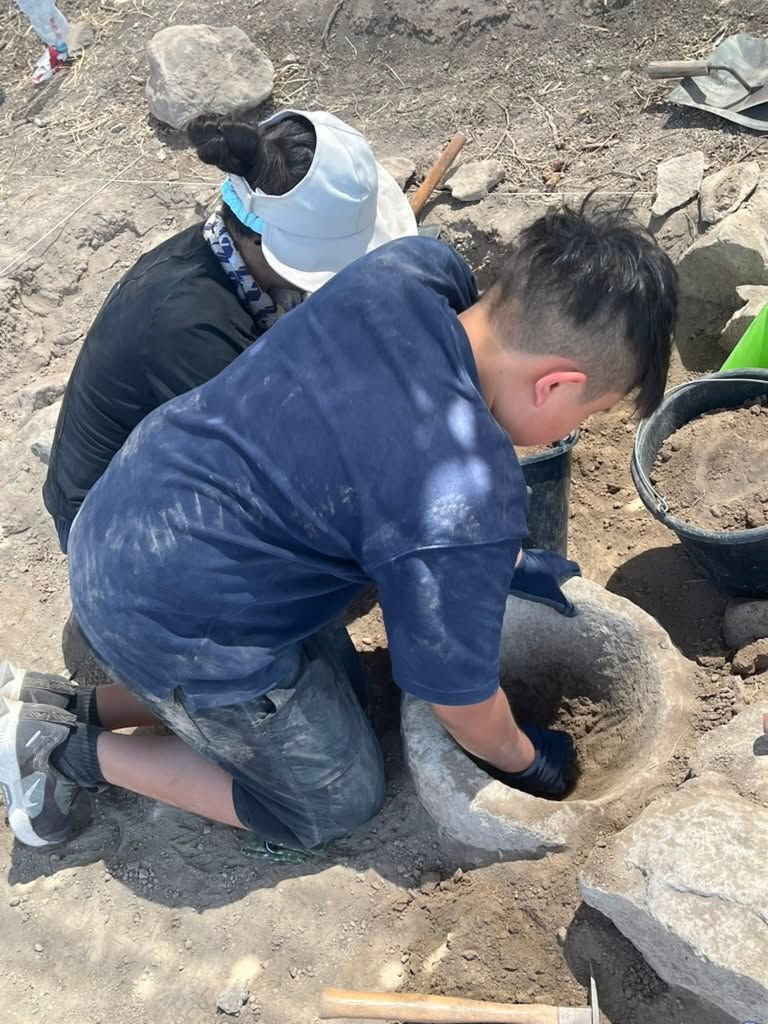
We are making very good progress in all the squares. All three areas (D, F, and G) are at the Roman level. There are scores of finds: coins, fishing weights, glass, jewelry, ceramic juglets, taboons (ovens) and chalk/stone vessels – the last item a clear marker for a Jewish presence. These are related to purity laws in Jewish tradition.
Indeed, this is an interesting point, that even though we are digging in some squares at the 2-3 century CE level – after the time when Bethsaida has transformed from a small Jewish fishing village to the city of Julias – the homes still bear significant evidence of a Jewish presence. Of course, there is a lot of area yet to be uncovered, and evidence of a mixed population would not surprise us. But for now, most of the homes should probably be considered Jewish homes.
I posted yesterday (Friday) about our field trip into the Jordan Valley, to the ancient Hasmonean fortress of Sartaba/Alexandrium (named for Alexander Janneus). We then visited Beth Alpha – a 6th century synagogue with a wonderfully decorated mosaic floor, followed by swimming in the turquoise, tepid pools of Sachne. We concluded our day with a visit to the Kohn-Tavor family on Maaleh Gilboa.
Today (Saturday) we turned our faces west to the cost. We were met at Nahal Tanninim (ancient Crocodilopolis) by Yeshu Dray who oversaw the extensive reconstruction of the ancient water system there –dams, sluices, and water wheels for grinding grain. We saw evidence of the earlier aqueduct system for Caesarea in the Roman period, but also the creation later of a small lake to flush the silting of the Byzantine harbor of the city.
We concluded our day enjoying the grand hospitality of Yeshu and Ilana at his workshop – where the magic happens. What wonderful folks!
We are now ready for our final week of digging with high hopes for what remains to be discovered.